

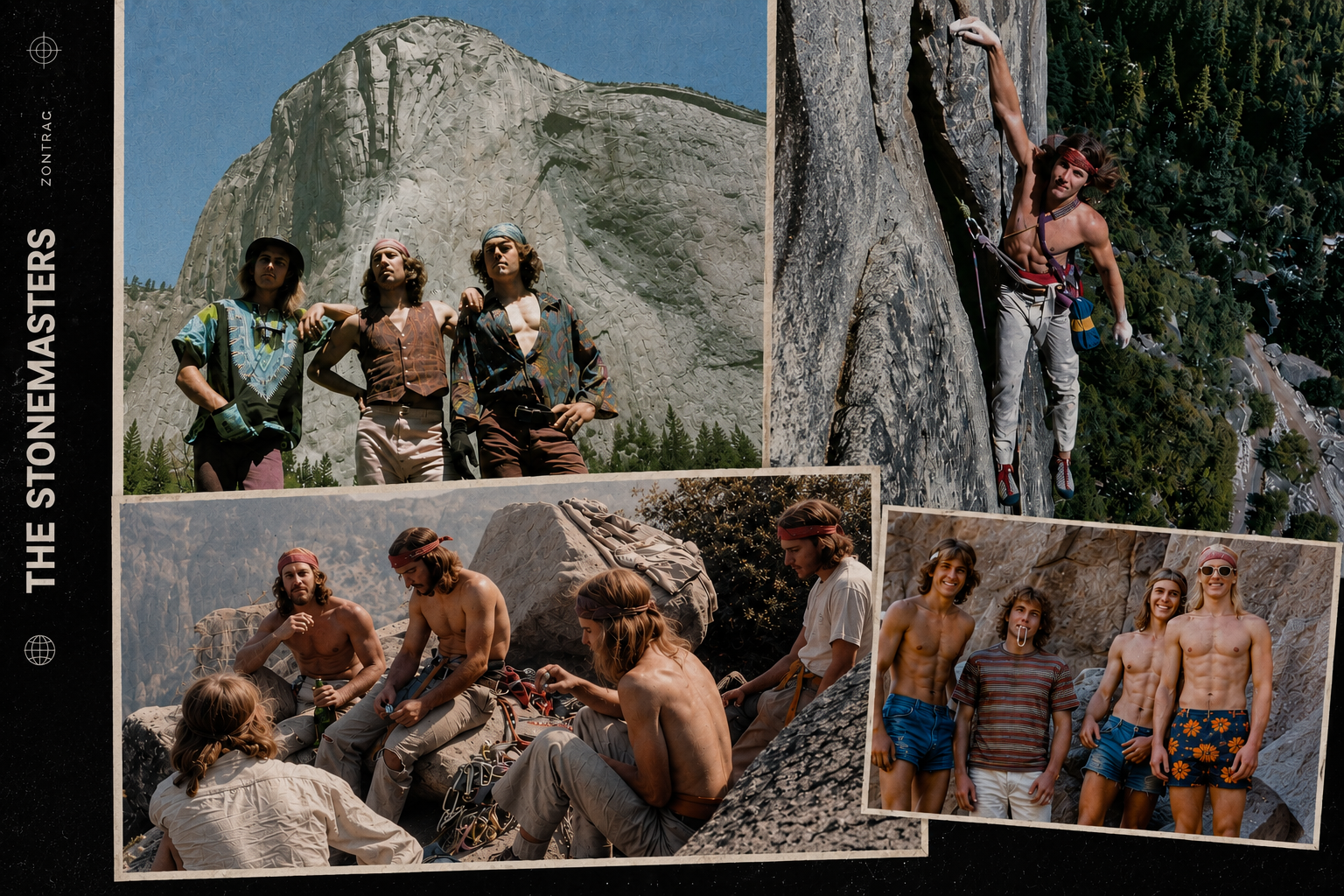
The Stonemasters didn't just climb harder—they redefined what a life outdoors could look like. Their influence still shapes modern climbing, trail culture and adventure today.
### The Stonemasters: The Rebels Who Changed Climbing Forever
Long before climbing became an Olympic sport, before GPS watches, carbon gear and social media, a small group of climbers in California quietly rewrote the rules of what was possible on rock. They weren't sponsored athletes. They weren't chasing followers. They simply wanted to climb harder, move faster and spend every possible day outside.
They became known as **The Stonemasters**.
Their legacy extends far beyond climbing. In many ways, they created the blueprint for today's outdoor culture—minimalist, adventurous, unconventional and deeply connected to nature.
## A Different Way of Living
The Stonemasters emerged during the early 1970s in Southern California before making Yosemite Valley their spiritual home. Rather than treating climbing as a weekend hobby, they built their entire lives around it. Most lived out of vans, tents or makeshift camps in Camp 4, working just enough to fund another season on the rock.
Money was never the goal. Freedom was.
Their philosophy would later become known as the "dirtbag" lifestyle—a term that once sounded insulting but is now worn almost as a badge of honor by climbers and thru-hikers around the world.
## The Birth of Modern Free Climbing
Until then, many big-wall routes relied heavily on artificial aid. The Stonemasters believed climbing should become more natural, more athletic and more elegant. Every generation pushes the limits of its sport, but this group fundamentally changed the direction climbing would take.
Among their achievements were:
* The first one-day ascent of **The Nose** on El Capitan.
* The groundbreaking first free ascent of **Astroman**, one of Yosemite's most iconic routes.
* New standards in bouldering, alpine climbing and big-wall ethics that would influence generations to come.
These weren't just impressive climbs.
They represented an entirely new mindset.
## More Than Climbers
What made the Stonemasters fascinating wasn't only their climbing ability—it was their culture.
They listened to jazz, surfed, skied, explored caves, paddled rivers and chased adventure wherever they could find it. Rules were questioned. Convention was ignored. Creativity mattered just as much as physical strength.
Figures such as **Jim Bridwell**, **John Bachar**, **Ron Kauk**, **John Long**, **Lynn Hill**, **Tobin Sorenson** and others each developed their own legendary reputation, but together they formed something far greater than the sum of its parts.
## Risk Was Part of the Equation
The 1970s were a different era.
Protection was primitive. Climbing shoes were basic. Weather forecasts barely existed. Rescue operations were limited. Falls carried far greater consequences than they do today.
The Stonemasters accepted that reality.
Many embraced risk as an unavoidable companion to exploration, believing uncertainty was part of what made climbing meaningful. While that philosophy produced extraordinary achievements, it also came with tragic losses that would shape climbing's history for decades.
Looking back today, their approach feels almost unimaginable.
## The Last Great Counterculture?
Modern outdoor sports are increasingly connected to brands, technology and performance metrics.
The Stonemasters belonged to a different world.
Their equipment was simple. Their budgets were almost nonexistent. There were no contracts, no influencer campaigns and no carefully curated identities online. Reputation was earned on the rock—not on a screen.
Ironically, many of the ideas that dominate today's outdoor industry—minimalism, fast-and-light movement, multifunctional gear, community over competition and living closer to nature—can all be traced back to this generation.
## Why They Still Matter
Even if you've never climbed a granite wall in Yosemite, you've probably experienced their influence.
Trail runners moving fast with lightweight packs.
Backpackers embracing ultralight philosophy.
Climbers choosing movement over equipment.
Outdoor communities valuing experience over possessions.
These ideas didn't appear overnight.
The Stonemasters helped shape them long before they became mainstream.
## ZONTRAC Perspective
The Stonemasters weren't trying to build a movement. They simply refused to accept the limits that existed before them. Their legacy isn't measured only by first ascents or climbing grades, but by a philosophy that still resonates today: travel light, stay curious, trust your partners and spend as much time outside as possible.
In an era driven by performance data and digital validation, their story is a reminder that the greatest adventures often begin with little more than a backpack, a few good friends and the willingness to see what lies beyond the next ridge.