
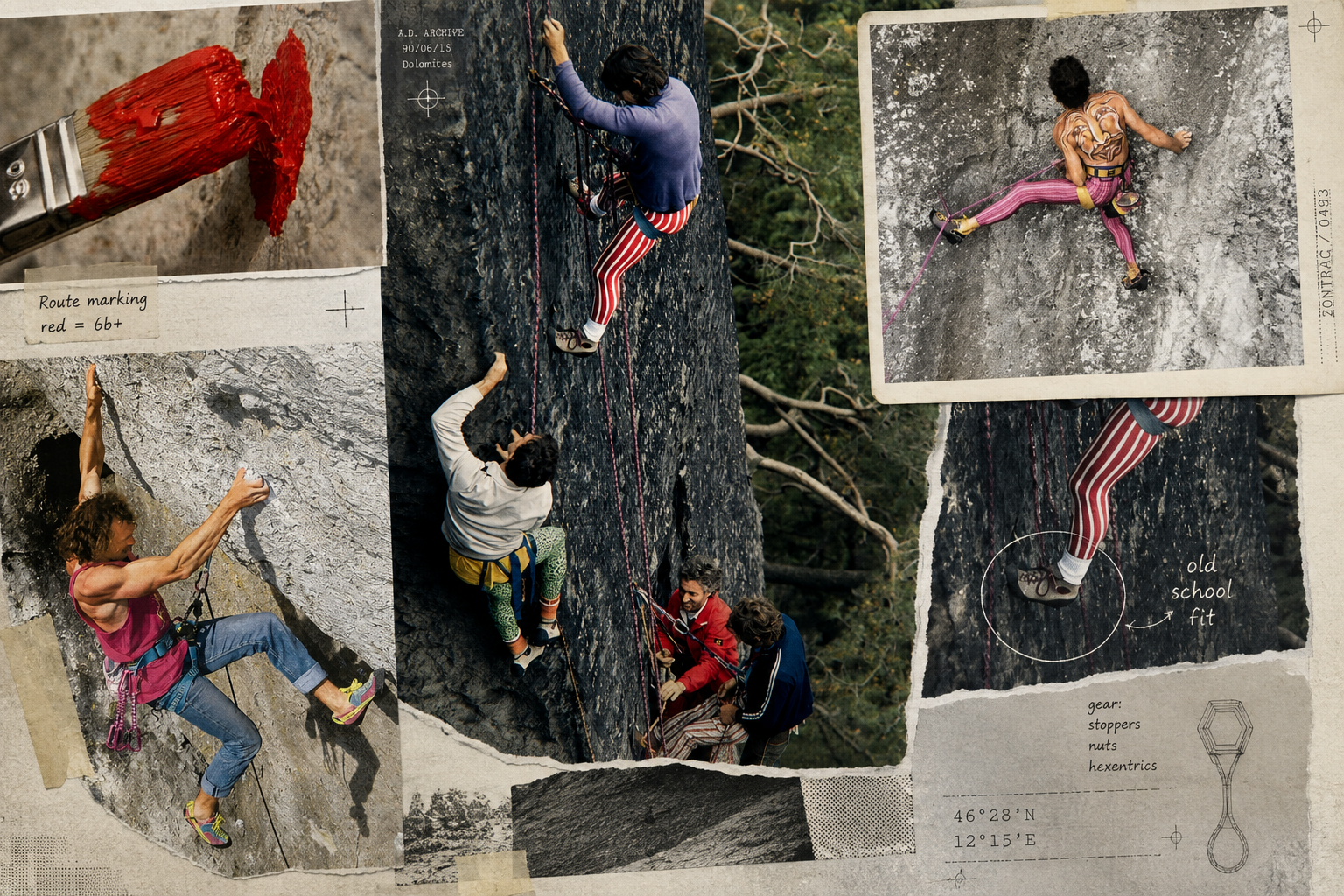
Rotpunkt is more than a climbing term. Born in Germany during the 1970s, it introduced a philosophy that redefined success—not by reaching the top, but by how you got there.
Every climber knows the term Redpoint.
It appears in guidebooks, climbing apps and route descriptions across the world. But few people know that the concept was born in Germany and started with nothing more than a small painted red dot.
What followed would permanently change the ethics of climbing.
The Birth of Rotpunkt
In the early 1970s, climbing looked very different from today. Many routes were climbed using artificial aid—pitons, slings and ladders weren't just there for protection, but were often used to pull upward through difficult sections.
A new generation of German climbers wanted something different.
Among them were Kurt Albert and his close friend Sepp Gschwendtner, who believed that the true challenge wasn't simply reaching the summit, but climbing every move using only the strength, balance and technique of the human body.
Protection should only catch a fall.
It should never help you move upward.
Whenever Albert successfully climbed a route in this pure style, he painted a small red dot—a Rotpunkt—at the base of the climb.
It wasn't a grade.
It wasn't a trophy.
It was a quiet statement.
This route can be climbed free.
More Than One Climber Changed the Sport
Although Kurt Albert became the face of the movement, Rotpunkt was never the work of one individual alone.
Together with Sepp Gschwendtner and a growing community of climbers in Germany's Frankenjura, they questioned long-established climbing traditions and developed a new philosophy built around honesty, self-reliance and respect for the rock.
Instead of adding more equipment to overcome difficult passages, they focused on becoming better climbers.
That simple shift in mindset transformed climbing forever.
Within only a few years, the idea spread from the limestone cliffs of southern Germany across Europe before eventually becoming the global standard for modern sport climbing.
Today, climbers everywhere use the English word Redpoint, yet its German origin remains visible every time someone records a successful ascent.
What Does "Redpoint" Actually Mean?
A Redpoint ascent doesn't require climbing a route perfectly on the first try.
Climbers are free to inspect the route, practise difficult sequences and work individual moves over multiple sessions.
The successful ascent, however, must be completed in one continuous effort—from the ground to the anchor—without falling, hanging on the rope or using equipment for upward progress.
The distinction may sound subtle.
In reality, it completely changed how climbers measured success.
The focus shifted from simply reaching the top to climbing with precision, control and integrity.
Onsight, Flash and Redpoint
Understanding Rotpunkt also means understanding how it differs from two other important climbing styles.
Onsight is considered the purest ascent. The climber has never attempted the route before, receives no information about the moves and completes it on the very first try without falling.
Flash also happens on the first attempt, but the climber may have watched someone else climb the route or received beta beforehand.
Redpoint allows unlimited practice before the successful ascent. The challenge is no longer discovering the moves but linking every sequence together in one flawless climb.
Each style demands exceptional skill.
They simply reward different aspects of climbing.
A Philosophy Beyond Climbing
Rotpunkt eventually became much more than a climbing term.
It represents patience over shortcuts.
Preparation over improvisation.
Mastery over convenience.
In an era increasingly obsessed with immediate success, the philosophy remains remarkably relevant. Progress doesn't happen because the route becomes easier.
It happens because the climber becomes better.
Perhaps that's why the small red dot still carries so much meaning more than fifty years later.
It's a reminder that the most rewarding achievements are earned through persistence, discipline and respect for the process—not by finding an easier way around the challenge.
ZONTRAC Verdict
Rotpunkt is one of the most influential ideas in the history of climbing. What began with Kurt Albert, Sepp Gschwendtner and a small group of visionaries in Germany's Frankenjura evolved into a philosophy that continues to shape modern climbing around the world. More than an ascent style, Rotpunkt is a mindset—one built on honesty, patience and the belief that true progress comes from improving yourself rather than relying on your equipment.