

Bikepacking did more than remove the rack. Soft bags turned the frame itself into a carrying system—and changed the bikes, routes and workshops built around travelling light.
For most of cycling history, carrying luggage meant adding structure to the bicycle. Steel racks, metal stays and rectangular panniers extended the machine outward, creating a stable platform for moving large loads over long distances. The system made sense for roads, touring bikes and journeys measured in weeks.
Bikepacking reversed that logic. Instead of building a platform around the bicycle, it began using the bicycle itself as the platform.
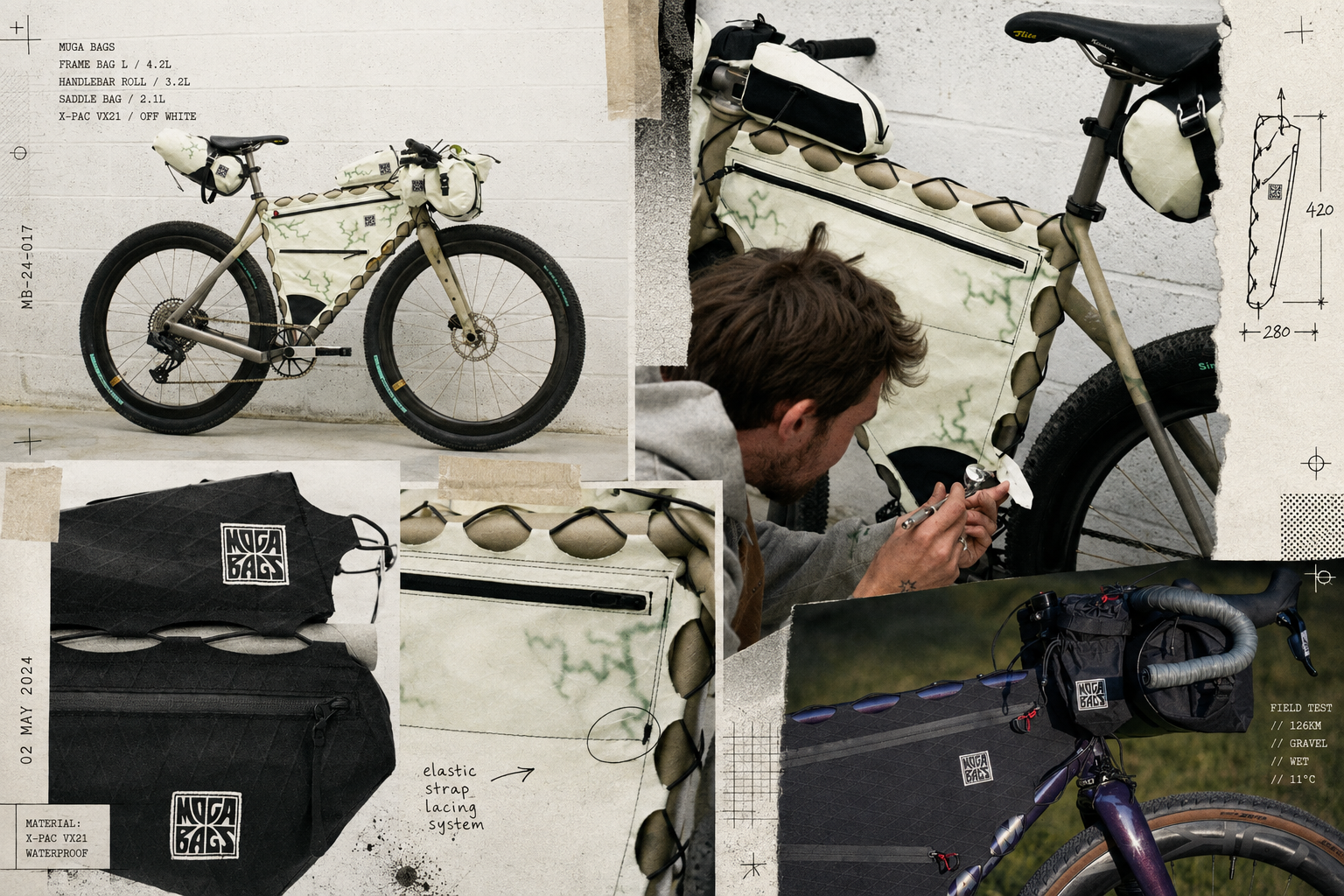
A frame bag occupies the empty triangle between the tubes. A seat pack grows behind the saddle without requiring a rear rack. A cylindrical roll sits between the drops. Smaller bags fill the top tube, stem and fork. Together, these components form a soft architecture that follows the geometry of the bike rather than sitting outside it.
The result was more than a lighter luggage system. It changed which bicycles could travel, which routes could be ridden and how equipment could be distributed across a moving machine.
The roots of this transformation are closely connected to endurance riding in terrain where conventional touring equipment becomes a liability. In Alaska, early snow-bike racers needed carrying systems that remained stable on rough trails, worked with unusual frame shapes and avoided racks that could loosen, break or interfere with deep snow. Revelate Designs founder Eric Parsons began making purpose-built frame bags in a basement workshop in 2007, initially for riders competing in events such as the Iditarod Trail Invitational.
The environment shaped the design language. Equipment had to sit close to the centreline of the bike, remain quiet over irregular ground and use spaces that had previously been treated as empty geometry.
That central placement is one of the system’s most important advantages. A loaded pannier creates leverage outside the bicycle’s frame and can make the rear of the bike feel detached from the rider’s input. A well-packed frame bag keeps dense items—tools, food, batteries or water—low and between the wheels. The bicycle remains narrower, and its behaviour changes less dramatically when the surface becomes loose or technical.
But the system is not simply a softer version of a rack.
Each position has its own structural problem. A seat pack must resist lateral movement while remaining compatible with the rider’s legs and rear tyre clearance. A handlebar roll has to avoid brake hoses, cables and the front wheel while preserving usable hand positions. A frame bag must accommodate bottle mounts, suspension layouts and increasingly varied tube profiles. Top-tube and stem bags need one-handed access without becoming unstable.
Straps, stiffeners, internal compression, anti-sway hardware and shaped panels therefore matter as much as fabric weight. The best bags do not merely attach to the bicycle; they manage movement between a flexible load and a rigid frame.
Materials have evolved with that demand. Traditional cut-and-sew constructions remain common because they are repairable and allow complex shaping, while laminated fabrics reduce water absorption and improve dimensional stability. Welded construction can remove stitched seams and create highly weather-resistant three-dimensional forms, but it requires different machinery and is less accessible to small workshops. The modern market now includes both approaches, from locally sewn systems to industrially welded bags designed for racing in prolonged rain.
This mixture of simple attachment and increasingly technical construction helped create an unusually broad design culture.
MOGA Bags represents the smaller, workshop-led side of that culture. Its made-to-measure Mogaéro system is shaped around the geometry of an individual bicycle rather than adapted from a standard size. Constructed from a single piece of fabric, the frame bag gives direct access to the zipper when repairs become necessary—turning serviceability into part of the architecture rather than an afterthought.
The approach reflects what independent bikepacking makers can contribute beyond low-volume production. Recycled X-Pac RX30, taped seams and a precise frame-specific fit create a stable, weather-resistant system, but the more significant detail is its relationship with longevity. MOGA treats the bag as equipment that should be maintained and repaired, not replaced when its first component wears out.
At the opposite end of the scale, brands such as Apidura pushed the category toward long-distance racing, where frontal area, weight, access and aerodynamic integration can be treated as parts of one system rather than isolated product decisions. Together, these different approaches show the range that now exists inside a format once defined largely by homemade and custom equipment.
The soft-bag concept also lowered the threshold for turning almost any bicycle into a travel machine. A gravel bike, hardtail, road bike or rigid commuter no longer required dedicated rack mounts before it could carry shelter and food. Bags could move between bikes, capacities could be adjusted for the route, and the distinction between a touring bicycle and an ordinary bicycle became less fixed.
That flexibility changed route planning. Narrow singletrack, hike-a-bike sections and broken surfaces became more realistic because the loaded bike remained compact. Riders could combine roads, forest tracks and trails without selecting equipment around the most conventional section of the journey.
There are limits. Soft systems generally carry less than a full rack-and-pannier setup. Poor packing can create sway, abrasion or unstable weight distribution. Small openings and tapered shapes make organisation less straightforward, while repeated strap contact can damage frame finishes. For heavy loads, long road tours or frequent access, panniers may still be the more rational solution.
This is precisely why the cultural difference matters. Bikepacking luggage does not promise maximum capacity. It asks the rider to define what the journey actually requires.
That question connected naturally with ultralight thinking, endurance racing and the growth of small independent gear makers. A frame bag could be prototyped by a skilled sewer without the tooling required for a metal rack or moulded case. Custom geometry rewarded local production. Riders supplied dimensions, makers refined attachment patterns, and product development remained close to actual use.
The workshop became part of the scene.
Today, the familiar combination of frame bag, seat pack and bar roll is almost a visual shorthand for contemporary off-road travel. Yet its importance is not the silhouette alone. The system made luggage behave more like part of the bicycle and encouraged riders to treat capacity, terrain and distance as connected design decisions.