

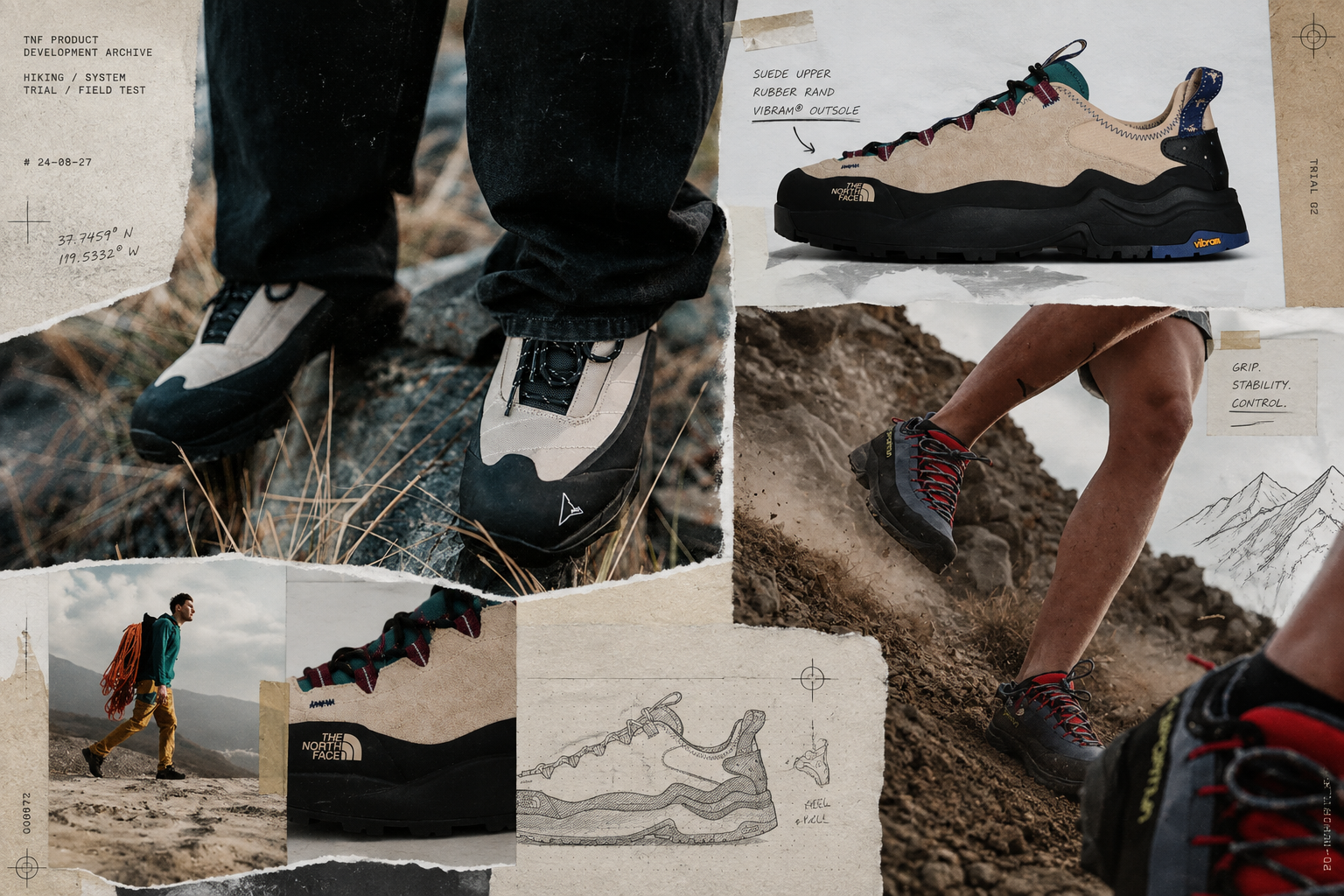
The approach shoe has left the crag. From ROA’s hybrid footwear to the Clyffe Trek, climbing codes are becoming gorpcore’s new language—technical in appearance, selective in function.
The approach shoe was never supposed to be the main event.
It was equipment for the terrain before the climb: stable enough for loose trails, precise enough for exposed rock and comfortable enough to reach the wall without walking several kilometres in climbing shoes. Its role was defined by transition.
That position produced a distinctive design vocabulary.
Laces extended unusually close to the toes. Rubber wrapped around the forefoot. Dense suede and abrasion-resistant textiles protected the upper. Low profiles kept the foot close to the ground, while flat climbing zones created contact on slabs and small edges.
Every visual detail once pointed toward a practical problem.
Now those same details are appearing far beyond the crag.
Approach shoes have moved into independent fashion stores, urban outdoor collections and everyday footwear rotations. Their compact proportions sit between the increasingly exaggerated trail runner and the conventional leather sneaker. They look technical without appearing engineered around speed. They carry the visual evidence of climbing without requiring the wearer to become a climber.
The approach is becoming the destination.
This transition is part of a wider change inside gorpcore. The first phase of the movement was easy to recognise: waterproof shells, trail-running shoes, fleece, down and equipment designed for visible performance. Technical credibility often arrived through logos, membranes and unmistakably modern synthetic construction.
The next phase is quieter.
Instead of searching only for the latest mountain technology, contemporary outdoor style is moving through the archives. Suede has returned. Low-profile footwear is replacing oversized trail silhouettes. Climbing laces, protective rands and traditional alpine colour combinations are being separated from their original categories and recombined as everyday design.
The result is not a rejection of performance. It is a more selective relationship with it.
The North Face Clyffe Trek demonstrates that shift clearly.
The shoe borrows from the brand’s alpine and climbing heritage, but it does not pretend to be a contemporary performance model. Its premium suede upper, webbing system and lacing extending toward the toe establish the visual language of an approach shoe. A rubber climbing zone beneath the forefoot, nylon shank and Vibram XS Trek EVO outsole with 4.5-millimetre lugs provide more structure and traction than a conventional lifestyle sneaker.
Underneath, however, the construction moves in another direction.
Plush midsole foam replaces the firm, ground-sensitive platform associated with more technical approach footwear. The fit is designed around everyday comfort rather than maximum precision. The silhouette remains low and familiar, closer to a sneaker than an alpine tool.
The North Face itself places the model in its lifestyle category.
That distinction matters because the Clyffe Trek is not simply an approach shoe made more fashionable. It is a lifestyle shoe built from selected pieces of approach-shoe architecture. Its technical references remain visible, and some remain functional, but they have been reorganised around a different use.
The shoe must work on an easy trail, but it must also work with wide trousers, technical outerwear and the less literal forms of contemporary outdoor style.
Its primary terrain is cultural.
This does not make the design dishonest. Outdoor equipment has always moved between specialist use and everyday life. Hiking boots became symbols of workwear and counterculture. Fleece escaped the midlayer system. Down jackets migrated from expeditions to winter streets. Trail-running footwear became a global fashion object long before most of its wearers entered an ultramarathon.
What is different is the precision with which the approach-shoe aesthetic is now being extracted.
A climbing-inspired lacing system changes the proportions of the upper. A rubber rand creates a harder boundary between shoe and ground. Suede softens the technical appearance while connecting the object to older alpine footwear. A Vibram outsole supplies both real traction and visible legitimacy.
Function and image become difficult to separate.
Few brands understood this space earlier than ROA.
Founded in Italy in 2015, ROA did not begin as a conventional outdoor company that later discovered fashion. It developed directly inside the overlap. Its footwear applied a sportswear attitude to alpine forms, creating products that could appear credible in rugged landscapes and contemporary fashion environments without fully belonging to either system.
The ROA Katharina makes that hybrid position explicit.
Its low silhouette, extended lacing, protective rubber construction and custom Vibram outsole reference the approach shoe directly. Depending on the version, leather, nubuck or technical textile uppers change the character, but the underlying architecture remains recognisable. It is compact, protected and visually close to the ground.
Unlike a purely cosmetic interpretation, the Katharina retains a meaningful relationship with uneven terrain. Vibram Megagrip outsoles, durable uppers and reinforced toes are not decorative additions. The shoe can move beyond pavement.
Yet it is not presented as equipment for a narrowly defined climbing objective.
ROA treats the approach shoe as a permanent hybrid rather than a transitional tool. The terrain can be a mountain path, an airport, a gallery or an unfamiliar city. The product does not need to change identity each time its surroundings change.
That ambiguity became one of the foundations of modern gorpcore.
The interesting contrast between ROA and The North Face is not simply independent label versus global corporation. It is the direction from which each arrives.
ROA was constructed within the intersection of outdoor function and fashion. The overlap is its original territory. The North Face enters the same space through its archive, translating an established history of climbing and alpine equipment into a softer lifestyle product.
One builds outward from hybridity. The other looks inward and reinterprets its own technical language.
The Clyffe Trek therefore says something larger about the maturity of gorpcore. Outdoor references no longer need to be introduced or explained. A climbing zone, toe-to-forefoot lacing and wraparound rubber are now readable design signals. They can be used with the same familiarity as a gum sole, a moccasin seam or a retro running profile.
The audience already understands the code.
That familiarity also creates a problem.
As approach-shoe design becomes more popular, technical appearance can easily be mistaken for technical capability. A deeply textured outsole does not automatically create security on wet rock. Protective rubber does not guarantee the lateral support needed for traverses. Extended lacing can suggest precision without producing the close, stable fit required for edging.
The Clyffe Trek contains functional components, but it should not be confused with a La Sportiva TX4 Evo.
The TX4 Evo remains organised around movement through technical terrain. Its fit, climbing zone, protective rand, tread geometry and controlled platform are intended for rock, scree and sustained approaches. Comfort exists in support of the objective.
The Clyffe Trek reverses that hierarchy. Its climbing references support the experience and appearance of an everyday shoe.
That difference becomes important when a route involves exposed scrambling, repeated edging or long sections of unstable ground. A lifestyle hybrid may offer considerably more traction and protection than an ordinary sneaker, but those qualities do not automatically turn it into mountain equipment.
Gorpcore becomes most interesting when this difference is visible rather than hidden.
The culture does not need every outdoor-influenced object to deliver maximum performance. A shoe can be selected because of its shape, materials, historical references and ability to move between daily environments. The problem begins only when visual function is presented as a substitute for actual function.
Used honestly, the Clyffe Trek represents a useful category.
It is a shoe for people whose everyday movement occasionally crosses gravel, forest paths, wet pavement and uncomplicated trails—but who do not require the rigidity, precision or specialist fit of a true approach shoe. Its soft construction and alpine references allow it to exist between urban sneaker, light hiker and climbing-derived lifestyle object.
ROA occupies a more assertive version of that space. The Katharina makes hybridity itself feel technical. It does not merely soften an established mountain shoe for the city; it treats the city and mountain as parts of the same design landscape.
That approach reflects how many people now engage with outdoor culture.
The boundary between an outdoor day and an ordinary day is becoming less distinct. Technical clothing is worn for cycling across town, walking through bad weather, travelling, working and entering the landscape without a complete change of system. Equipment is expected to remain useful without requiring a specific expedition to justify its existence.
The appeal of the approach shoe follows the same logic.
It is less aggressive than the modern trail runner, less nostalgic than the traditional hiking boot and more structurally expressive than the standard sneaker. It contains enough real function to make everyday movement easier, but enough cultural ambiguity to avoid looking like equipment chosen from a checklist.
Its relevance also comes from what it represents.
Approach footwear was designed for the space between recognised activities. It served the movement before the climb and the descent after it. That in-between status now feels unusually contemporary. Outdoor culture itself is increasingly shaped by overlap: between trail and street, performance and style, independent production and global influence, specialised equipment and daily systems.
The approach shoe did not become fashionable despite being difficult to categorise.
It became fashionable because it is difficult to categorise.
For ZONTRAC, that is the more interesting story. The Clyffe Trek is not the next breakthrough in fast-hiking footwear, and presenting it as one would miss the point. It is evidence that climbing’s secondary shoe has become a primary cultural object.
The route to the rock created the form.
Gorpcore gave it another destination.