
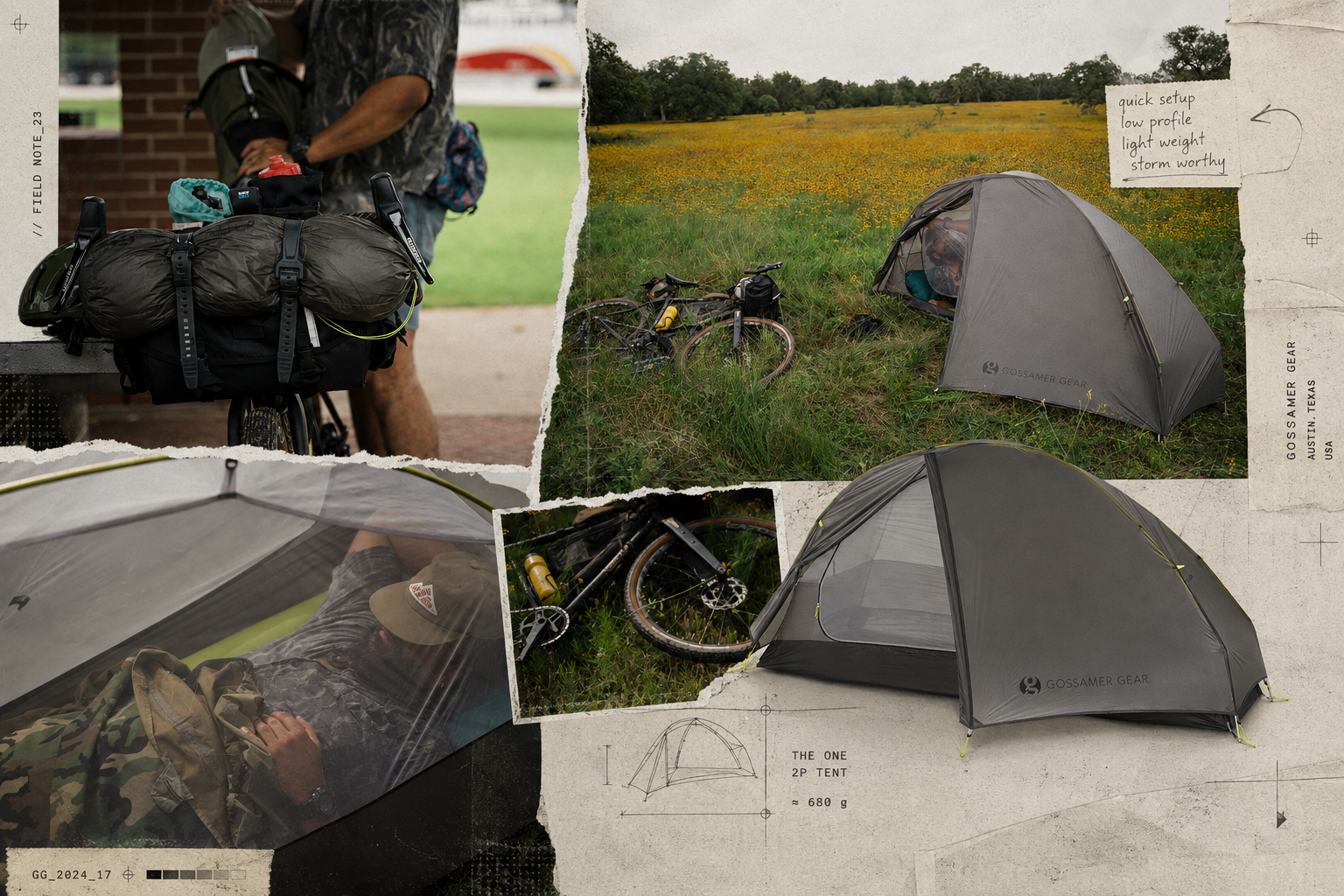
Gossamer Gear’s first freestanding tent combines a double-wall structure, dedicated poles and an 845-gram trail weight. The Free 1P brings convenience back into the ultralight equation.
Ultralight tents usually ask the user to participate in the structure.
Trekking poles become tent poles. Guylines create tension. Stakes define the floor. The quality of the pitch depends on soil, angles and the ability to read the ground.
Gossamer Gear’s The Free 1P takes a different route.
It stands before the first stake enters the ground.
The brand’s first freestanding tent uses a dedicated DAC aluminium pole system to support a separate inner tent and rainfly. The body, fly and poles weigh 845 grams—keeping the complete shelter structure below two pounds without relying on trekking poles.
That combination is the central achievement.
Freestanding tents never disappeared from backpacking. They remained the default choice for users prioritising simple setup, predictable interior volume and the ability to move an assembled shelter.
What changed was their position within ultralight culture.
As weight targets became more aggressive, dedicated poles were increasingly treated as unnecessary. Single-wall constructions, trekking-pole tents and tensioned shelters demonstrated how much mass could be removed when the user’s existing equipment became part of the architecture.
The Free reintroduces the pole set without abandoning the ultralight target.
Its DAC NFL 8.7-millimetre aluminium structure uses a central swivel connector, corner clips and colour-coded hardware to simplify pitching. The inner tent can stand on wooden platforms, rock, compacted soil or other surfaces where stakes are difficult to place.
The rainfly’s vestibule still needs to be pegged out to provide its full protected storage area. Stakes and guylines are also recommended whenever wind enters the equation.
“Freestanding” therefore describes the supporting structure, not complete independence from anchors in every condition.
That is normal for the category.
Its benefit is flexibility.
A poorly positioned trekking-pole shelter often has to be dismantled and pitched again. The Free can be assembled, lifted and rotated until the door, slope and sleeping direction make sense. For bikepacking, rocky camps, established platforms and wet evenings when a fast pitch matters, this convenience has practical value.
The weight requires some clarification.
The frequently quoted 845 grams includes the inner tent, rainfly and poles. Adding six stakes, four guylines, the stuff sack, pole bag and repair section brings the complete system to approximately 936 grams.
That remains light for a genuinely freestanding double-wall shelter.
It is simply a more useful number for anyone packing the complete system rather than comparing manufacturer trail weights.
The Free uses Gossamer Gear’s new ClearSkies fabric, now appearing across The One, The Two and Twinn Tarp.
The material combines 15-denier recycled Robic nylon with a 20-denier dope-dyed ripstop grid and a silicone/polyurethane coating. It is PFAS-free, factory seam-taped and rated by Gossamer Gear at 4,923 millimetres of hydrostatic-head resistance.
More important than the headline figure is the purpose of the construction.
Thin tent fabrics have to balance water resistance, tear behaviour, UV exposure, packed volume and weight. Gossamer Gear’s decision to develop one material platform across several shelters suggests ClearSkies is not simply a fabric selected for The Free, but a broader attempt to improve consistency across the brand’s tent range.
Long-term field use will show how the lightweight recycled fabric responds to repeated pitching, abrasion and ultraviolet exposure.
The double-wall layout provides a more established advantage.
Separating the inner tent from the rainfly helps manage condensation and keeps direct contact with a wet fly away from the sleeping area. It also allows airflow through the mesh body while maintaining insect protection.
For humid routes and camps with limited ventilation, that separation can be worth more than the weight saved by a single-wall design.
The interior is intentionally compact.
The floor measures 218 centimetres in length, 86 centimetres wide at the head and tapers to approximately 55 centimetres at the foot. Peak height is 99 centimetres, with a total floor area of 1.53 square metres.
A standard rectangular 25-inch—or 64-centimetre—sleeping mat technically exceeds the narrower part of the floor. Gossamer Gear states that it will fit by pushing slightly into the side walls, but recommends a wide tapered mat for a cleaner fit.
User height is another important consideration.
The brand recommends The Free for people up to approximately 188 centimetres. Taller sleepers, particularly those around 193 centimetres or more and using a thick insulated mat, may touch the ceiling or the sloping ends.
This does not make the tent unusually small for the ultralight one-person category.
It makes the target user specific.
The Free is designed around a minimal solo footprint, not around providing one-and-a-half-person space under a one-person label. Users wanting room for a wide rectangular mat, equipment beside the sleep system or a taller body will need to assess that trade-off carefully.
Where the tent becomes especially convincing is for hikers and bikepackers who value independence from trekking poles.
Cyclists do not normally carry walking poles, so a trekking-pole tent requires an additional support set. Once those optional poles are included, the weight advantage becomes smaller while the shelter retains its dependence on tension and good stake placement.
The Free arrives with its structure already resolved.
Hikers may appreciate the same separation. Trekking poles remain available for evening movement, river crossings or side trips while the tent stays standing at camp.
At $400 in the United States, The Free occupies a sensible position below many shelters using Dyneema Composite Fabric. European pricing is higher after import and distribution, with early listings around €490.
The appeal is not that Gossamer Gear has created the lightest possible enclosure.
Much lighter shelters exist.
The achievement is combining a recognisable double-wall tent experience with a weight that no longer feels incompatible with an ultralight equipment list.
There are fewer instructions hidden inside the weight saving.
No pole-height calculation. No structural dependence on loose soil. No requirement to make hiking equipment perform a second job.
The Free does not reject ultralight logic.
It applies that logic to convenience.