

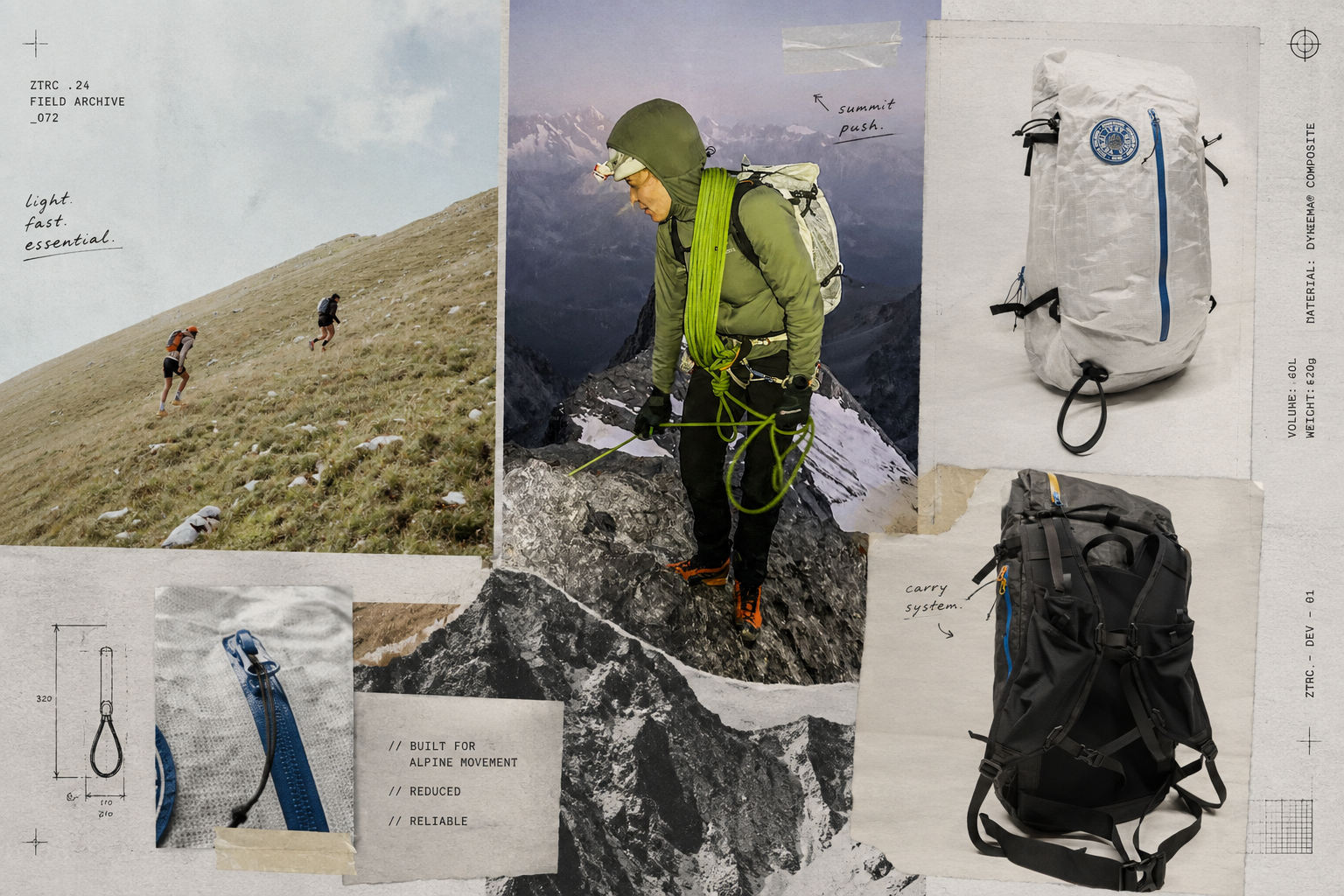
What Happened builds ultralight backpacks around individual bodies and specific mountain objectives. Its repair-led model proposes a different idea of how an outdoor brand can grow.
Most backpacks begin with an average.
An average torso length. An expected load. A standard pocket layout. A body imagined broadly enough to justify producing the same object hundreds or thousands of times.
What Happened begins with one person.
In her Slovenian workshop, product designer Neža Peterca makes ultralight backpacks for specific bodies, equipment systems and mountain objectives. A customer may need a pack for climbing, ski mountaineering, fastpacking or a remote expedition. The process starts with a conversation about that use—not with a standard size selected from a menu.
What will the pack carry?
Where should the weight sit?
Which equipment needs to remain accessible?
What failed on the previous backpack?
The answers determine the design.
Peterca adjusts back-panel length, volume, materials, pockets, attachments, closures and zip placement. A climbing pack can receive ice-tool tunnels and external gear loops. A running-oriented construction may use vest-style shoulder straps with space for soft flasks and food. Other packs are organised around skis, ropes, crampons or the specific dimensions of expedition equipment.
The result is not personalisation applied to a finished product.
It is product design beginning with the person who will use it.
Peterca entered technical bag design through a less direct route. Originally trained in graphic design, she co-founded the Budapest cycling-bag label Blind Chic in 2010. As that company grew, her role moved increasingly away from making and towards administration, collections and the repeated demands of expansion.
She later spent two years working with Patagonia’s Worn Wear programme, repairing technical garments across Europe. When the travelling programme stopped during the pandemic, she established her own repair workshop in Slovenia.
Its name came from the first question asked whenever damaged equipment arrived:
What happened?
That question still defines the brand.
Repairing equipment reveals a product differently from designing it. The construction is no longer an ideal drawing or pristine sample. It is a record of tension, abrasion, overloading, failed components and repeated movement.
A damaged zip shows where access becomes stressed.
A torn attachment point reveals how force travels through the bag.
Worn shoulder straps show where the body and product have negotiated badly.
Repair turns use into information.
Peterca carries that knowledge into each new construction. Instead of treating damage as a problem belonging only to an old product, she uses it as evidence for the next one.
This creates a design process based on accumulated field experience.
Mountain guides are particularly valuable within that system. Some use their backpacks for more than 200 days each year, exposing materials, seams and attachments to a level of repetition difficult to recreate through a short product test. Their feedback does not arrive as an abstract consumer preference. It identifies which decisions continue working after months of rock, snow, moisture and heavy loads.
What Happened translates that information into frameless packs made primarily from lightweight UHMWPE-based materials such as Dyneema and ULTRA. These fabrics offer high strength relative to their weight and resist water absorption, making them well suited to demanding mountain use.
The material alone, however, does not create a successful backpack.
Frameless construction makes fit and packing technique especially important. Without a rigid internal structure compensating for poor proportions, the relationship between torso length, shoulder straps, back panel and load becomes more direct.
This is where custom construction provides its clearest functional advantage.
A shorter person may need substantial capacity without the long back panel typically associated with that volume. A climber may want a narrow profile that remains stable while moving through technical terrain. A fastpacker may prioritise immediate access to hydration, food and poles over the cleaner exterior preferred for alpine hauling.
Standard products solve these conflicts through compromise.
What Happened can solve them individually.
The current custom ultralight climbing backpack starts at €720. It includes an adjustable choice of volume, back-panel size, materials, colours, pockets, attachments, closures and zip configuration. The standard architecture provides a front volume pocket, side access to the main compartment, compression straps, gear loops, ice-axe attachments and padded contact areas.
The custom running vest costs €500 and can similarly be adapted through material, pocket, closure and colour choices. Its standard configuration combines soft-flask and food storage on the shoulder straps with side access and additional external volume.
These are significant prices.
But they reflect a process that cannot be separated from labour. Consultation, pattern adaptation, material preparation and individual construction are contained within one object. The customer is not paying only for fabric and hardware, but for direct access to the designer’s accumulated repair and field knowledge.
The current ordering system is more structured than the idea of traditional bespoke equipment might suggest. Products have recognisable base architectures, prices and selectable options. Custom orders are made without permanent inventory, with a stated lead time of approximately two to three weeks.
This hybrid model is important.
What Happened is not creating every backpack from an empty sheet of paper. Proven foundations are adapted to different bodies and uses. Repeating successful constructions keeps the work viable, while individual decisions preserve the relevance of custom production.
There are also clear trade-offs.
A custom order requires the customer to understand their own needs. More options do not automatically create a better pack, and a feature imagined before the journey may prove unnecessary during it. Because each product is made for a particular customer, custom orders cannot be returned.
The dialogue therefore carries responsibility on both sides.
Peterca sometimes has to remove an idea rather than add one. Custom design works best when it filters requirements—not when it attempts to include every possible solution in one backpack.
That restraint separates useful custom equipment from expensive novelty.
It also defines What Happened as a countermodel to conventional scaling.
Outdoor companies generally grow by reducing variation. Materials are ordered in larger quantities. Patterns stabilise. Production moves away from the designer. A successful product becomes valuable because it can be repeated efficiently.
What Happened grows by accumulating knowledge.
One repair informs one construction. One guide exposes a weak point. One custom solution becomes available to the next conversation. The object changes gradually without becoming a seasonal replacement for what came before.
This model cannot supply a mass market.
It does not need to.
Scale can also be measured through depth: how long a product remains useful, how closely it serves its owner and how much knowledge returns to the maker after it enters the field.
The opportunity for What Happened lies in preserving that direct exchange while the brand becomes more visible. Collaborations, carefully repeated base models and small product categories can expand its reach without turning the workshop into the type of business Peterca originally chose to leave.
Growth does not have to mean producing the same backpack for more people.
It can mean applying the same attention to more specific problems.