

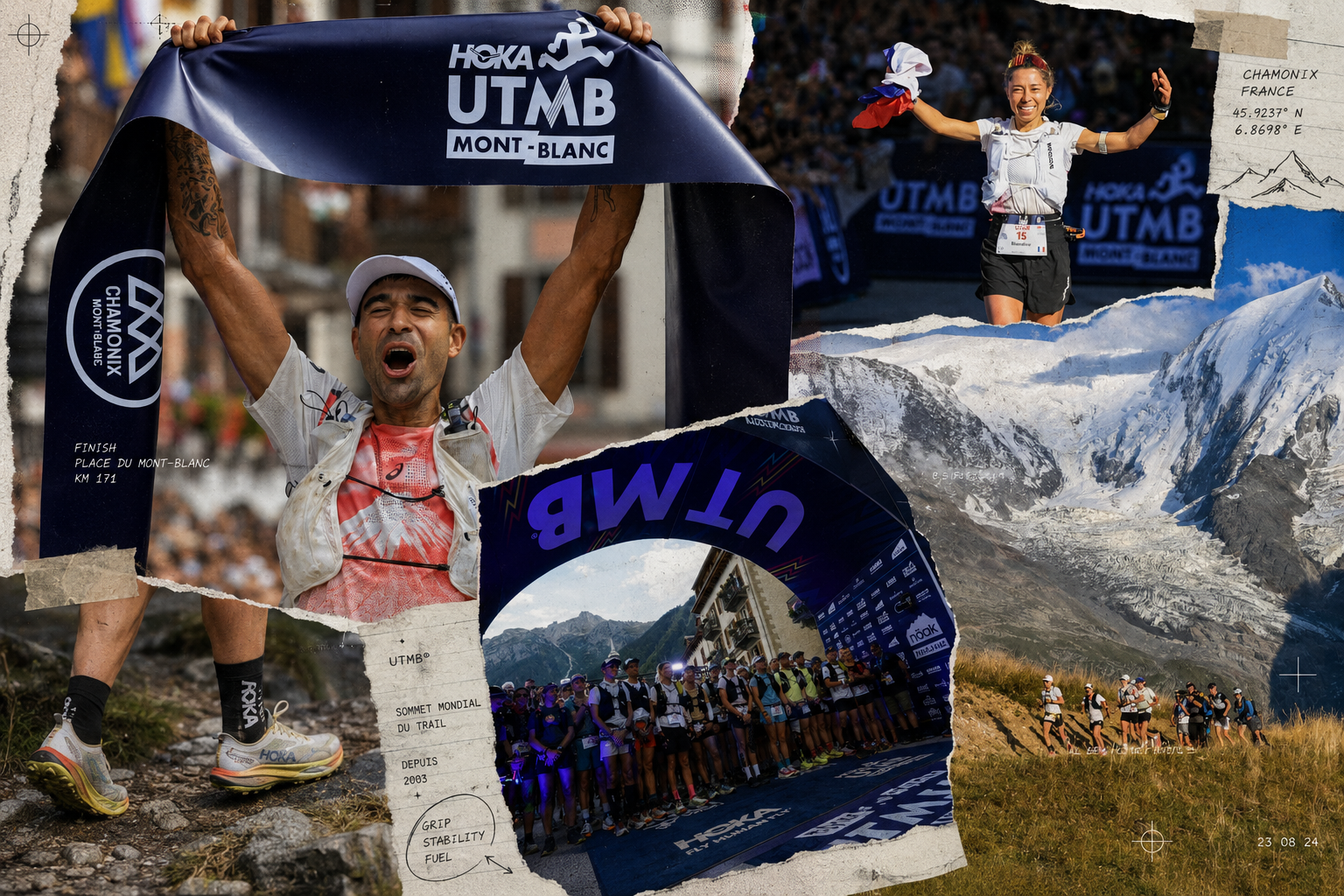
Ben Dhiman and Blandine L’Hirondel ran the fastest winning times in UTMB history. A modified course complicates the record—but not the scale of their performances.
Ben Dhiman crossed the finish line in Chamonix in 18 hours, 16 minutes and 29 seconds.
No man had completed a UTMB race faster.
Blandine L’Hirondel followed in 21 hours, 54 minutes and 49 seconds.
No woman had completed one faster either.
Dhiman became the first runner in UTMB history to break 19 hours. L’Hirondel became the first woman to finish below 22. Three men completed the race inside 19 hours, while ten finished below 20.
Measured by the clock, the 2026 UTMB was unprecedented.
Measured as a course record, it becomes more complicated.
Thunderstorms over the Mont Blanc massif forced organisers to delay the start by two hours and remove the Pyramides Calcaires section from the route. The exposed passage above the Col des Pyramides Calcaires is one of the highest and most technical parts of the Italian section.
Its removal made the 2026 route different from the complete course used in previous editions.
This is where the language of records becomes important.
A fastest time describes what happened.
A course record suggests that the same test was completed faster.
Those statements are not interchangeable.
Trail races rarely offer the controlled repetition of a stadium track or certified road course. Snow, storms, erosion, access restrictions and safety decisions can alter the route before or during an event. Even when the start and finish remain in the same place, the ground between them may not.
UTMB makes that instability especially visible.
The race travels around Mont Blanc through France, Italy and Switzerland, crossing high passes, valleys and exposed alpine terrain. Weather is not an external complication added to the event. It is part of the environment that gives the race its identity.
Organisers therefore have to balance continuity with safety.
Removing a dangerous section does not diminish the event. It allows the event to continue under conditions in which maintaining the original route would create unnecessary risk.
But it changes what the finishing time can represent.
Dhiman’s 18:16:29 is the fastest men’s UTMB time ever recorded. It should not be treated as a direct replacement for performances achieved on a longer or more demanding version of the course.
The same applies to L’Hirondel’s 21:54:49.
Her time was faster than Katie Schide’s 22:09:31 from 2022, but Schide completed a different version of the route. One number cannot completely rank the two performances because the underlying tests were not identical.
That does not make comparison meaningless.
It makes comparison more interesting.
Dhiman did not simply benefit from a shortened route. He controlled a remarkably fast race, moved into the lead before the halfway point and continued building his advantage. His time was more than an hour faster than the previous year’s winning mark, and he finished over 31 minutes ahead of Baptiste Chassagne.
The modified course contributed to the final number.
It did not produce the victory.
L’Hirondel’s performance was equally substantial. After a close opening phase, she separated from Rachel Entrekin and built a commanding lead through the second half of the race. Even after several falls during the final descent, she became the first French woman in a decade to win UTMB.
She also joined the small group of athletes to have won OCC, CCC and UTMB.
The historic value of those performances does not depend entirely on whether they enter a record table.
Trail running has inherited much of its public language from road and track competition. Records provide simple headlines. They allow an audience to understand progress immediately and give broadcasters a clear narrative as a runner approaches the finish.
But mountain races resist that simplicity.
A faster time can result from stronger athletes, deeper competition, improved training, more efficient equipment, better nutrition or faster aid-station transitions. It can also reflect dry trails, cooler temperatures, revised paths or the removal of a technical section.
Usually, several of these factors operate at once.
The clock records their combined result.
It cannot separate them.
That is why course records in trail running should be treated as contextual achievements rather than absolute measurements. They remain valuable, but only when the course, weather and competitive conditions surrounding them remain visible.
The alternative is not to stop recording times.
It is to describe them more precisely.
Dhiman and L’Hirondel produced the fastest winning times in UTMB history on the 2026 course. That statement is accurate, significant and does not require their performances to be forced into a comparison the mountain cannot support.
This distinction protects the athletes as much as the record.
Calling the results invalid because the route changed would ignore the race they actually completed. Calling them directly superior to every previous performance would ignore what changed beneath their feet.
Both positions reduce the complexity of the event.
UTMB’s value has never rested on one permanent configuration. Its identity comes from travelling around the same mountain through terrain that remains dynamic. The race changes because the landscape changes.
The athletes adapt to the version they are given.
In 2026, they adapted exceptionally quickly.