

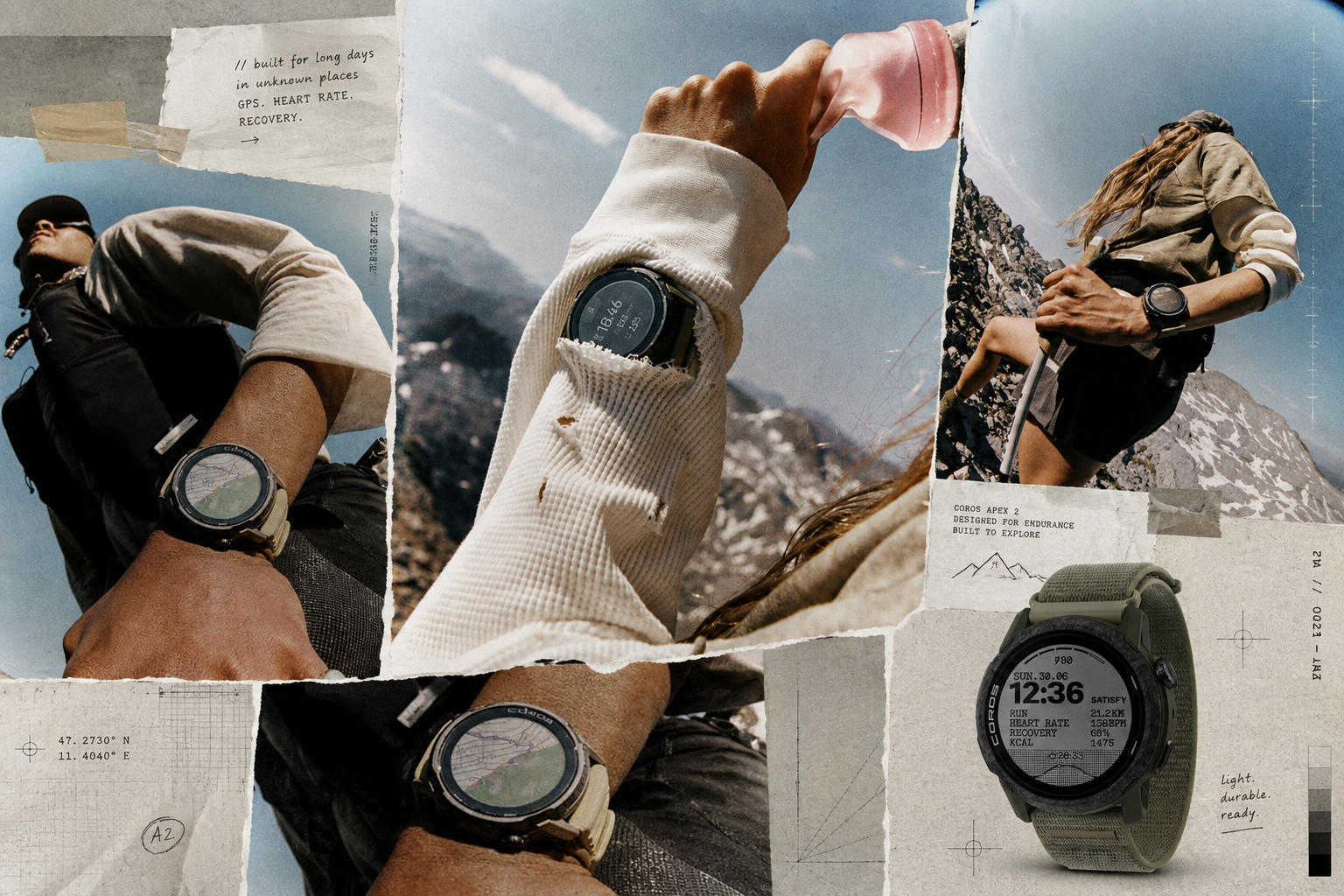
Satisfy transforms the COROS APEX 4 through crystallised titanium, exclusive interfaces and a distinct material language—without changing the proven technology underneath.
What happens when Satisfy designs a sports watch?
The answer is not another sensor, metric or performance claim.
It is a different way of seeing the instrument.
The Satisfy × COROS APEX 4 is a limited 46-millimetre edition of COROS’ mountain sports watch. Its dual-frequency GPS, mapping, sensors, display, battery and software remain identical to the standard model.
Satisfy’s contribution begins where those specifications end.
The most visible change is the ice-crystallised titanium bezel. Extreme heat and controlled cooling alter the internal structure of the metal, creating an irregular, frost-like pattern. Micro-etching exposes the crystalline grain before a transparent carbon coating adds abrasion resistance while preserving the raw appearance of the titanium.
Because the pattern forms through the material process rather than being printed onto the surface, every bezel is slightly different.
That distinction matters.
Technical products are usually designed for consistency. Components, finishes and interfaces should appear identical across every unit. Here, controlled
irregularity becomes part of the product’s identity.
Satisfy extends this language across the watch.
An engraved case back, a Worn Sage nylon strap and a grooved green silicone strap replace the conventional appearance of performance electronics with something quieter and more tactile. The nylon feels weathered rather than pristine, while the muted colours connect naturally with Satisfy’s wider vocabulary of washed fabrics, mineral surfaces and running equipment designed to gain character through use.
Three exclusive watch faces bring the same approach into the interface.
The Physical Overview consolidates distance, heart rate, recovery, calories and daily effort. A weather display prioritises temperature, precipitation, humidity and UV information before the run. A weekly overview presents distance, elevation, endurance and training load as one continuous rhythm rather than a collection of isolated activities.
These faces do not expand what the APEX 4 can measure.
They reconsider which information deserves attention at a particular moment.
That is a subtle but relevant form of design. A sports watch may collect hundreds of data points, but its usefulness depends on hierarchy. The athlete rarely needs everything at once. Interface design determines whether information feels like guidance or noise.
Beneath the Satisfy treatment remains a capable mountain platform.
The watch combines a 1.3-inch always-on Memory-in-Pixel touchscreen with sapphire glass, dual-frequency GPS, global offline maps, turn-by-turn navigation, a dual-range barometer and tools for heart rate, HRV, sleep, recovery and training load.
COROS claims up to 65 hours of GPS use for the 46-millimetre model. With the nylon strap, the watch weighs 51 grams. A built-in microphone and speaker support voice notes, audio alerts and hands-free calls.
These are not exclusive collaboration features, but they provide the reason the collaboration works.
Satisfy did not need to construct a new technical platform to establish a different identity. COROS already supplied the accuracy, endurance and navigational capability. The design intervention could therefore concentrate on how the instrument looks, feels and communicates.
This is increasingly relevant as performance products become technically similar.
GPS watches can compare routes, monitor recovery, measure elevation and organise weeks of training. The differences between them are no longer expressed only through accuracy or battery life. Interface, material finish and visual language now influence which object a runner wants to wear every day.
That does not make performance secondary.
It acknowledges that technical equipment also participates in culture.
A watch communicates before it records a single kilometre. Its size, colour, surface and typography position the wearer within a particular understanding of movement. Traditional mountain watches often express capability through bulk, dark finishes and aggressively rugged details.
Satisfy offers another interpretation.
The crystallised bezel suggests weathered stone or frozen metal without becoming decorative in a conventional luxury-watch sense. The muted straps reduce visual noise. The exclusive faces organise complex data through a recognisable graphic system.
The result remains clearly technical, but it no longer feels anonymous.
At $520, the collaboration carries a moderate premium over the standard 46-millimetre APEX 4. That difference does not buy additional GPS accuracy or battery capacity. It covers a distinctive material treatment, two straps, an engraved case back, exclusive interfaces and the limited nature of the edition.
For runners choosing entirely through specifications, the standard model provides the same functional foundation.
For those who also consider material, interface and identity, the Satisfy edition offers something the specification sheet cannot fully describe.
The important test will be how the watch ages.
Its crystalline surface should not turn it into an object protected from use. The strongest expression of the collaboration will come after the bezel, straps and casing have accumulated their own marks from rock, weather, sweat and distance.
Technical identity becomes convincing when it survives contact with the activity it represents.