

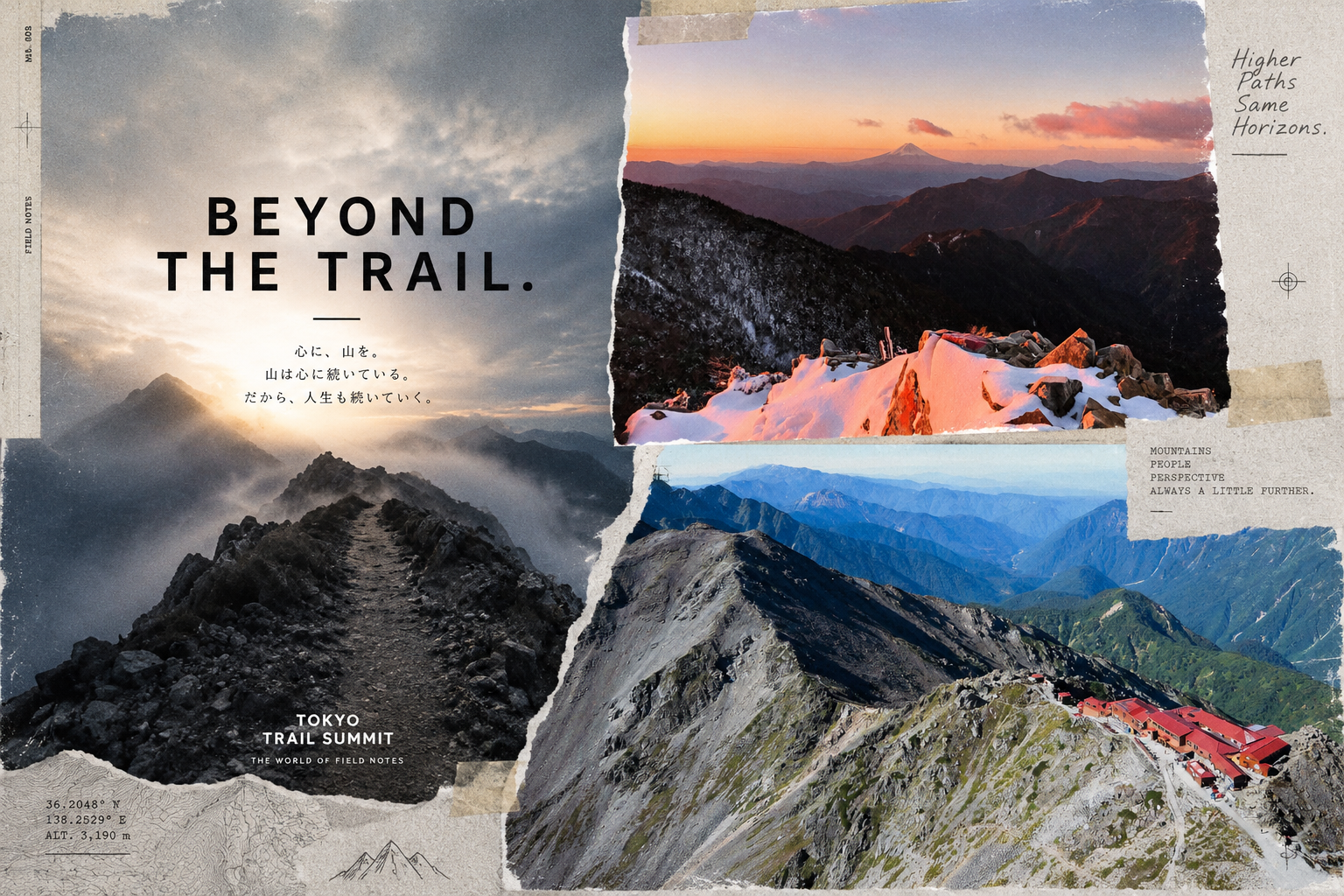
Beyond the Trails brings guides, hikers and conservation voices together in Ashikaga. Its location asks where knowledge about Japan’s outdoor culture should be exchanged.
Japan’s outdoor image often arrives through Tokyo.
Products are launched there. International media visits there. Brands, retailers and creative studios use the capital to translate Japanese hiking culture for a global audience.
The knowledge behind that culture lives elsewhere.
It exists in mountain communities, pilgrimage routes, nature schools, guiding practices and regional organisations responsible for the landscapes people travel to experience.
Beyond the Trails Summit moves that conversation outside the capital.
The one-day event takes place on 5 September 2026 at Watarase River Plaza in Ashikaga, Tochigi Prefecture. Seven speakers from Japan and abroad will address hiking, guiding, conservation, tourism, safety, pilgrimage and outdoor culture.
Ashikaga is not remote.
The city remains accessible from Tokyo in approximately one to two hours, depending on the connection. That proximity is part of the idea. The summit does not reject the capital or isolate itself from its audience. It creates enough distance for a different centre of gravity to emerge.
Tokyo becomes the point of departure rather than the default location.
The event is organised for both Japanese and international participants. Presentations will primarily be delivered in English, while questions, conversations and community interaction can take place in English and Japanese.
That bilingual structure responds to a genuine gap.
International residents and visitors often experience Japan’s outdoors through fragmented information. Maps, transport systems, mountain huts, access rules and safety guidance may not be available consistently across languages. Knowledge circulates through local websites, guide relationships and informal conversations that are difficult to access from outside the community.
At the same time, an English-language outdoor discussion can easily simplify the culture it wants to make accessible.
Japanese trails do not form one unified system. A pilgrimage route, national park, satoyama landscape and alpine climbing area carry different histories, responsibilities and relationships with surrounding communities.
Translation therefore involves more than replacing Japanese words with English ones.
It requires context.
The programme’s range creates space for that context. Long-distance hiking appears alongside mountain safety. Conservation is connected to responsible recreation. Guiding is discussed together with tourism and regional communities. The Kumano Kodo introduces pilgrimage as a form of movement shaped by culture and belief rather than only distance or performance.
Participation from organisations such as Ōsugidani Nature School brings another layer.
Based in a region affected by depopulation and demographic change, the school uses local nature, people and cultural knowledge within environmental education. Its work connects outdoor access with questions that rarely appear in destination marketing: who maintains regional knowledge, how it reaches the next generation and what happens when the communities surrounding a landscape become smaller.
This is where Beyond the Trails can become more than a collection of adventure stories.
Japan does not lack outdoor expertise.
It lacks enough spaces in which different forms of expertise meet.
Guides understand risk and decision-making in real terrain. Conservation organisations understand ecological pressure and long-term stewardship. Regional tourism workers understand the economic value of visitors. Local residents understand the rhythms and limits of the place itself.
Hikers encounter all of these systems without always seeing them.
A summit can make the connections visible.
Its location in Ashikaga reinforces that potential. The city lies north of Tokyo in Tochigi, within reach of the wider Kantō region but outside the cultural and commercial concentration of the capital. Holding the event there redirects attention toward the places from which outdoor participation actually begins.
Regional location alone, however, does not guarantee regional perspective.
An event can leave Tokyo physically while carrying the same voices, formats and assumptions with it. A stage remains a stage. English can widen international access while also becoming the dominant filter through which Japanese experience is presented.
Beyond the Trails addresses part of this through bilingual questions and conversations.
The most important moments may occur between the scheduled presentations.
A participant asking a guide about an unfamiliar route.
A conservation worker explaining why access has changed.
A Japanese hiker translating a local practice that does not have a simple English equivalent.
An international resident sharing which parts of Japan’s outdoor system remain difficult to understand.
These exchanges do not require a polished conclusion. Their value lies in creating relationships through which future information can move.
The event also welcomes people without extensive hiking experience. That openness matters because outdoor knowledge is often distributed through confidence. Experienced participants already know which questions to ask, which organisations to follow and how to interpret incomplete route information.
Beginners do not.
A community format can lower that threshold by placing professional knowledge and personal experience in the same room. Safety, conservation and regional respect become part of entering outdoor culture rather than specialist subjects encountered later.
Beyond the Trails is therefore best understood as infrastructure for conversation.
It does not need to define Japanese outdoor culture in one day. No group of seven speakers could represent a landscape stretching from subtropical islands to northern alpine terrain.
Its opportunity is smaller and more useful.
It can connect people who normally operate in separate parts of the outdoor system. It can make regional expertise more visible to an international audience. It can allow new hikers to understand that a trail is never only a line through scenery.
The summit finishes after one day.
Its real value depends on what continues afterwards.
If the conversations lead to shared hikes, regional visits, collaborations and a more active bilingual community, Ashikaga becomes more than an alternative event location. It becomes the beginning of a network.
The outdoor conversation does not need to abandon Tokyo.
It needs more places from which to speak.