

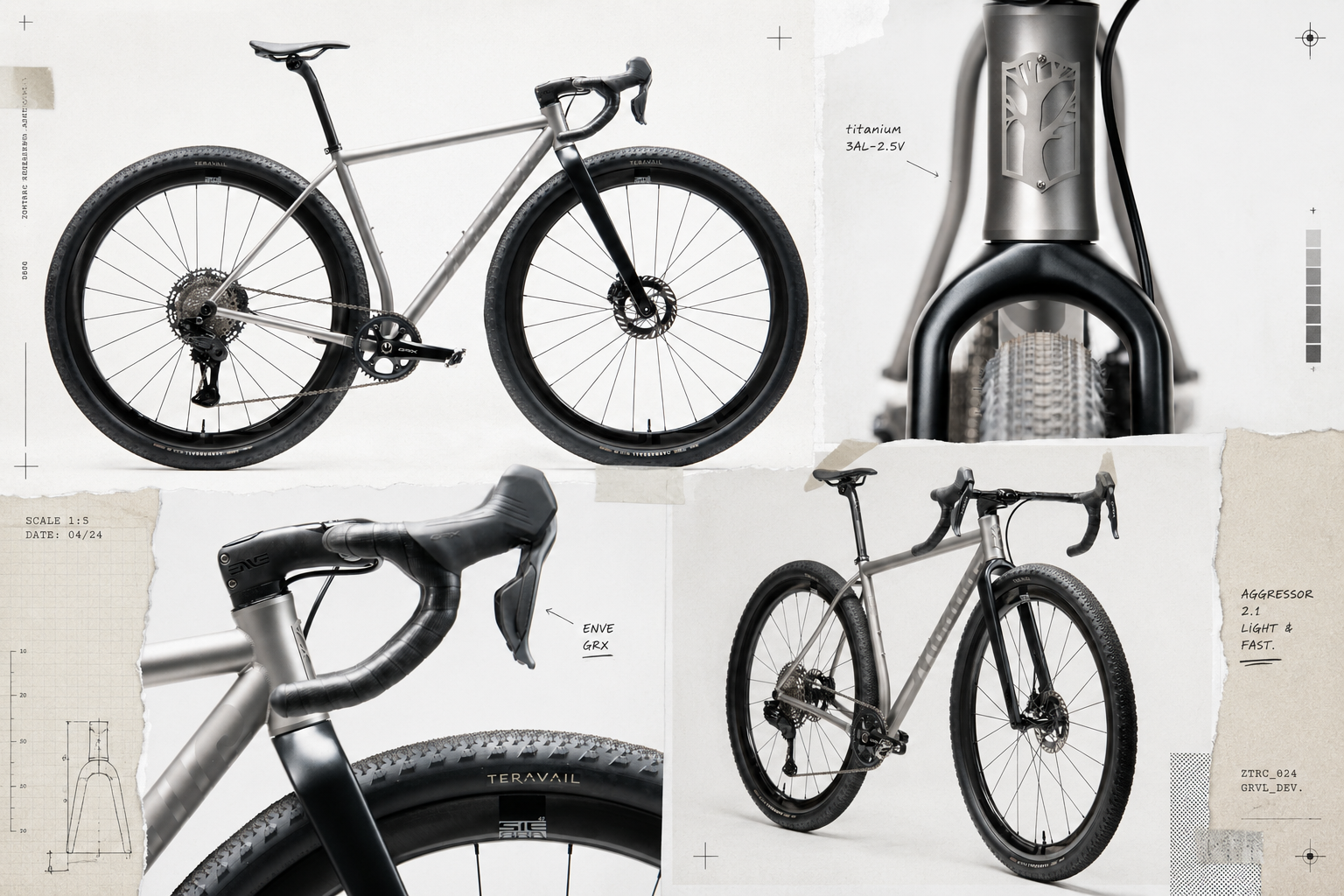
Mosaic’s titanium GT-1 i55 32 makes 32-inch gravel wheels orderable, not theoretical. The larger format promises calmer speed and easier rollover—but demands an entirely new bicycle around it.
The bicycle industry had almost finished arguing about wheel size.
Mosaic has restarted it.
The GT-1 i55 32 is a handmade titanium gravel bike built around 32-inch wheels. It appeared publicly at the 2026 MADE Bike Show after months in which larger wheels had moved through prototypes, custom builds and race experiments without becoming a coherent commercial system.
Mosaic’s distinction is simple.
This one can be ordered.
That does not make it proven. It makes the question more serious.
A larger wheel meets an obstacle at a shallower angle. In theory, that allows it to pass over rocks, holes and broken surfaces with less disruption. Its contact patch may become longer rather than simply wider, while the additional rotational inertia can help preserve speed across rough, open terrain.
The sensation should be calmer.
Once moving, a 32-inch wheel has more interest in continuing straight ahead. That could suit fast gravel, long-distance racing and mixed-surface routes where maintaining momentum matters more than changing direction repeatedly.
The benefit is easiest to understand when the obstacle is large enough that the tyre cannot simply deform around it. On ordinary gravel, casing construction, pressure, tread and tyre volume may influence speed more than another increase in wheel diameter. A supple 700C tyre at the correct pressure already absorbs a great deal before the rim’s size becomes decisive.
Bigger does not automatically mean faster.
It does mean the entire bicycle must change.
The GT-1 i55 32 accepts tyres up to 55 millimetres wide. Mosaic uses a bent seat tube and a 3D-printed titanium yoke to move the rear wheel forward while retaining clearance for a one-by drivetrain and chainrings up to 46 teeth. The frame uses 110 × 15-millimetre front and 148 × 12-millimetre rear axles, bringing mountain-bike spacing into the gravel platform.
The fork required its own solution.
A conventional 32-inch fork would raise the front of the bike, increase stack and make the steering geometry increasingly difficult to control. Mosaic developed a carbon fork under its Zero Components label with a 445-millimetre axle-to-crown length and 60 millimetres of offset.
The shorter construction limits front-end height. The additional offset helps manage trail and creates more room between the rider’s toes and the tyre.
This is the most convincing part of the bike.
Mosaic did not place large wheels inside an existing silhouette and call the result innovation. The wheel diameter altered the fork, rear triangle, axle standards, drivetrain clearance and fit strategy. The company treated the bicycle as a system.
That system remains difficult to package.
A larger wheel occupies space in every direction. Short chainstays become harder to achieve. Toe overlap becomes more likely. Standover increases. Preserving clearance can lengthen the front centre or push the rider upward, producing a bicycle that feels stable because its proportions have become cumbersome.
Mosaic offers rider-specific geometry through its made-to-order programme, allowing those compromises to be distributed differently for each body. Its published batch geometry extends from 50 to 62 centimetres, but the smallest size still lists a standover height above 800 millimetres.
Customisation can improve the result.
It cannot repeal diameter.
The platform will therefore remain easier to justify for taller riders. A large wheel can look and behave proportionally beneath a large frame, while the same format asks much more of the geometry around a smaller rider. The claim that 32 inches can work across a wide size range needs independent riding evidence, not only a detailed drawing.
Weight creates another unresolved question.
A bigger rim requires more material. Spokes become longer. Tyres contain larger casings. Any additional mass sits far from the hub, where it has a greater effect on rotational inertia. That inertia may help a wheel retain momentum, but the rider must first accelerate it.
A wheel that feels composed across washboard can feel reluctant when repeatedly brought back to speed. It may also require more deliberate steering through tight corners and low-speed technical sections.
Construction can reduce these penalties, but usually through expensive carbon rims, light casings and carefully selected components. Mosaic has not published a complete-bike weight that makes the exchange easy to judge.
The component ecosystem is beginning to exist rather than being fully established.
There are now genuine 32-inch tyres and carbon wheelsets available, including gravel-oriented options. More manufacturers have announced products for 2027. Yet the selection remains tiny beside 700C, where riders can choose among numerous tread patterns, casings, widths, rim depths and price levels.
That scarcity matters beyond shopping.
Tyres wear out. Rims crack. Equipment gets damaged during travel. A replacement for a 700C gravel wheel can be found in almost any serious bicycle market. A 32-inch rider may need to carry spares, wait for shipping or accept that a single failure can end the trip.
The new standard promises easier passage across terrain while making passage through the supply chain more difficult.
Price concentrates the risk.
The fully integrated GT-1 i55 32 frameset starts around $8,250. A semi-integrated version of the platform begins around $5,000. These are custom titanium bicycles produced in small numbers, so ordinary mass-market value is not the correct measure.
But the cost changes what the bike can prove.
A bespoke frame can resolve fit problems individually, absorb low-volume component pricing and serve a rider already comfortable with experimental equipment. It does not demonstrate that the same wheel size belongs on an affordable production bike available across seven conventional sizes.
Mosaic has built an answer for the person most able to accommodate the question.
That is still meaningful.
New wheel formats rarely arrive as mature systems. The early 29er was criticised for slow handling, weak wheels, unsuitable forks and poor proportions on smaller frames. Many of those complaints were accurate until geometry and components caught up.
Thirty-two inches may follow the same path.
It may also discover that 29-inch wheels combined with increasingly wide, sophisticated gravel tyres already occupy the useful middle ground. A 50- or 55-millimetre 700C tyre offers volume, traction and impact control without abandoning the largest component ecosystem in cycling.
The Mosaic does not invalidate that solution.
It tests what lies beyond it.